
Introduction
Across the ancient world, trade was not merely an economic activity but a civilizational force — shaping cities, cultures, and political fortunes. Among the early societies of the Indian subcontinent, Tamilakam stood out as one of the most maritime-minded regions. The Sangam corpus — composed between the 3rd century BCE and the 3rd century CE offers vivid glimpses of bustling ports, long-distance voyages, and cosmopolitan markets. Supplemented by Greek and Roman records, archaeological finds, and inscriptions, these sources present a remarkably detailed picture of a dynamic seafaring civilization that linked the Indian Ocean world from Rome to China.
In ancient Tamil society, trade was viewed as both a stimulus for progress and a foundation of prosperity. Sangam literature identifies agriculture, craft production, commerce, fine arts, education, and sculpture as essential components of a thriving economy. Yet, scholars agree that agriculture and trade were the two dominant sectors.
The poets of the era celebrated wealthy farmers and merchants alike. Agricultural surplus was converted into capital through commerce, creating a self-sustaining economic cycle. Tamilakam’s trade network was highly integrated — inland towns supplied produce and handicrafts, while coastal ports served as gateways to international markets. This system ensured that prosperity was not confined to royal courts but flowed into urban centres and rural hinterlands alike.
Ports and the Coastal Economy
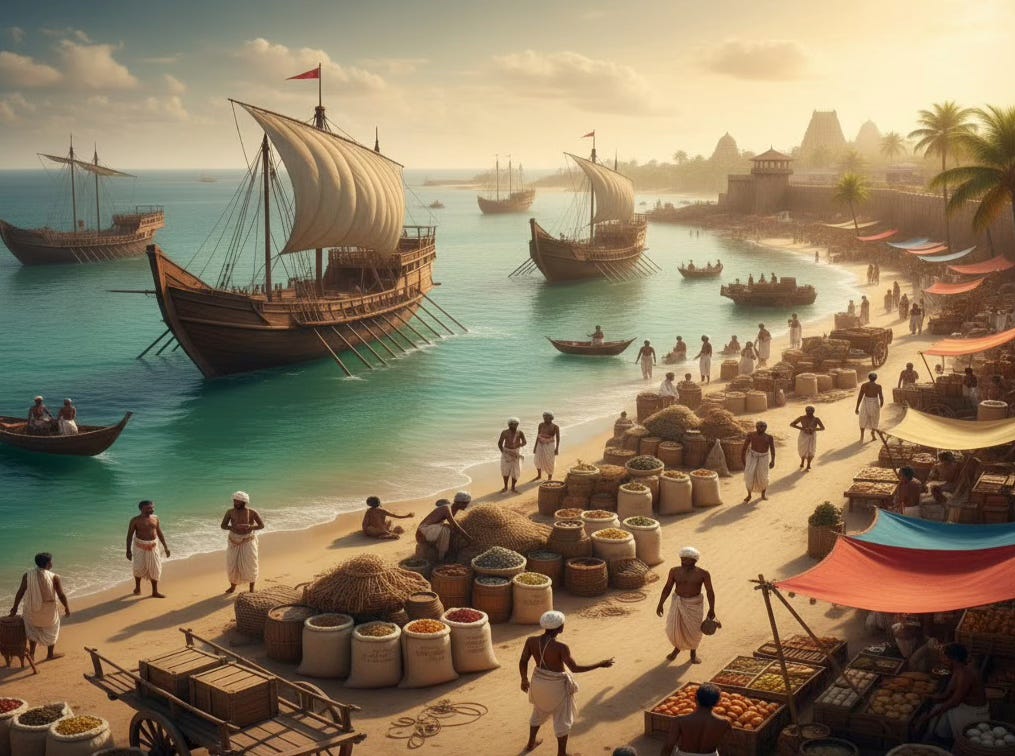
By the early centuries BCE, Tamilakam’s east coast had become a necklace of flourishing ports. Among them, Kaveripoompattinam or Poompuhar, the port city of Cholas, was the most famous. Located at the mouth of the River Kaveri, it was one of the great urban centres of the Sangam world. Descriptions in the Pattinappaalai and Silappadikaram portray Puhar as a cosmopolitan emporium filled with warehouses, markets, and ships laden with goods from far-off lands. Pattinappalai describes the import and export activities at Puhar like this
Mazhai pozhintha neer kadal parappavum,
Maari peyyum paruvam pola,
Neerinindrum nilaththu etravum,
Nilaththinindru neer parappavum.
Like water flows from Ocean to Hills only to return as rain, goods go to the land from sea and from land back to sea
The Sangam texts also mention that large ships with sails entered Poompuhar without even lowering their masts, suggesting that it was a spacious and well-designed harbour capable of accommodating such vessels arriving at high speed. This vividly illustrates the advanced maritime infrastructure and navigational expertise that existed in ancient Tamil ports.
The city’s streets overflowed with commodities — horses brought by sea, bales of pepper transported by carts, gold and gems from northern hills, sandalwood and eaglewood from western forests, pearls from southern seas, corals from eastern waters, wheat from the Gangetic plain, and rice from the fertile Kaveri delta. Ships bearing colourful flags stood anchored in rows “like elephants tethered on the shore.” Barter transactions were common: paddy was exchanged for white salt, and goods arriving by sea were traded for inland produce.
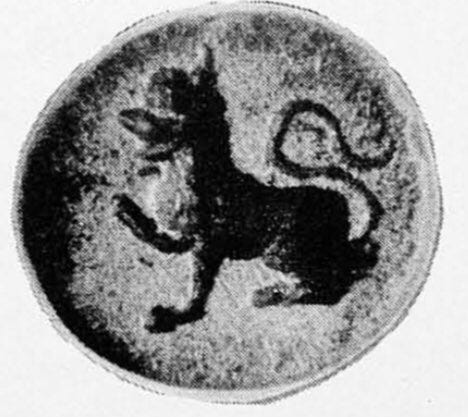
The Pattinappaalai also records that large warehouses were constructed near the port to facilitate trade and storage. It mentions that customs formalities were carried out in these buildings, where imported and exported goods were inspected and taxed. Once the goods cleared customs, they were sealed with the Chola emblem of the tiger (“Puli Porithu Purampokki,” ) before being dispatched.
Of the other ports dotted the coastline: Korkai, the ancient Pandyan harbour on the Gulf of Mannar, was famed for its pearl-diving industry. The Madurai Kanchi vividly describes the bustling trade activity. It notes that when large ships, known as Vangam, arrived loaded with merchandise, the merchants who brought these goods would sell them amidst loud and lively calls. The poem also mentions that the Yavanas ( Greeks / Romans) — brought horses to Tamilakam and took back jewels and precious goods in exchange.
The Chera port city of Muziris is also mentioned in several Sangam texts. Agananuru beautifully captures its bustling maritime trade in the lines:
“Yavanar thantha vinaiman nan kalam
Ponnodu vanthu kariyodu peyarum
Valankezhu Musiri.”
This verse describes Muziris, the prosperous port “where the fine ships of the Yavanas arrive with gold and sail back with pepper.” A small boat sails down the river filled with fish,
and returns home loaded with paddy. The sacks of pepper stored in houses are carried on that same boat to the seashore. The gold brought in by the ships is transported from the anchorage to the shore in small boats. This shows that apart from bigger ships, small boats transported goods
Tondi, another port city, handled aromatic imports such as sandalwood, camphor, and textiles. Boats from these harbours carried pearls, conch bangles, tamarind, salt, and dried fish along the coast, while larger vessels connected the Tamil ports with Arabia, Africa, and Southeast Asia.
Archaeological Evidence and the Indo-Roman Connection
Archaeology has confirmed the Sangam poets’ depictions. Excavations at Arikamedu, near Puducherry, revealed a large settlement containing Roman amphorae, wine jars, beads, glassware, and coins dating from the 3rd century BCE to the 3rd century CE. These findings prove the site’s role as a major Indo-Roman trading station.
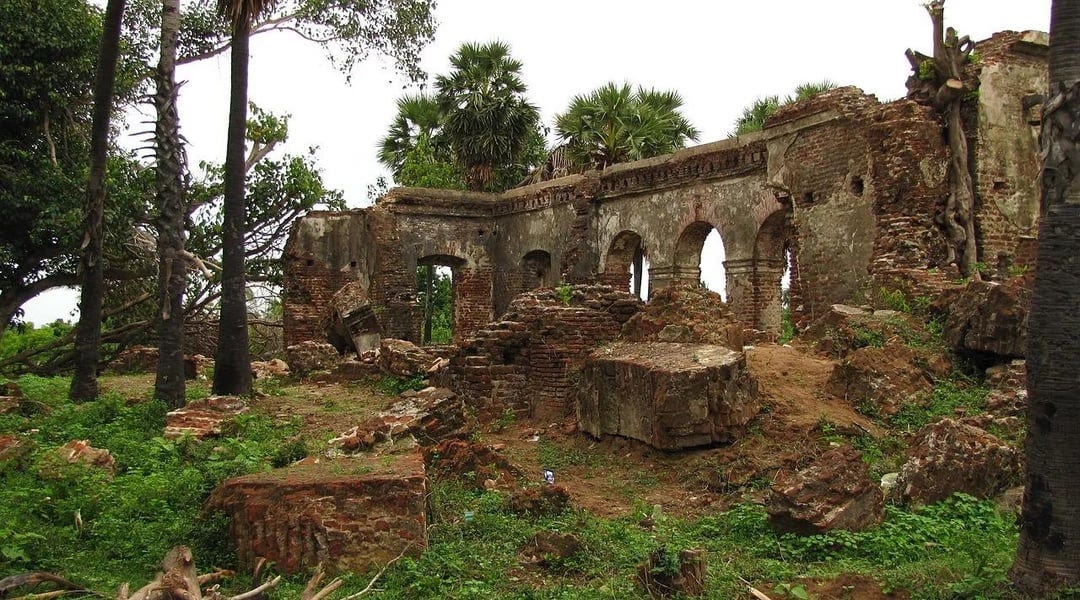
Arikamedu
Similar evidence has been unearthed at Alagankulam, Korkai, Karur, and Madurai, suggesting a network of interconnected coastal and inland trading hubs.
Kodumanal is mentioned in the Pattitrupathu as “Kodumaṇam patta vinai mān arun kalam.” This reference indicates that the town was renowned for its fine craftsmanship and production of rare ornaments. Archaeological excavations at the site have revealed numerous artefacts, including potsherds inscribed in Tamil-Brahmi script, beads, and gemstones, confirming its importance as an ancient industrial and trade centre known for jewellery making and lapidary work.
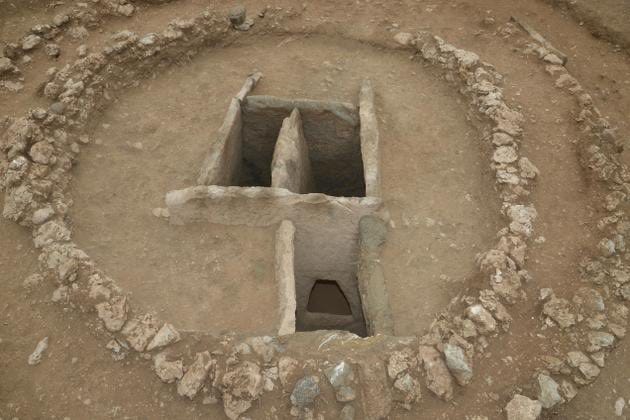
Kodumanal Archealogical Site
Roman coins bearing the images of emperors from Augustus to Nero have been found in large numbers across Tamil Nadu.
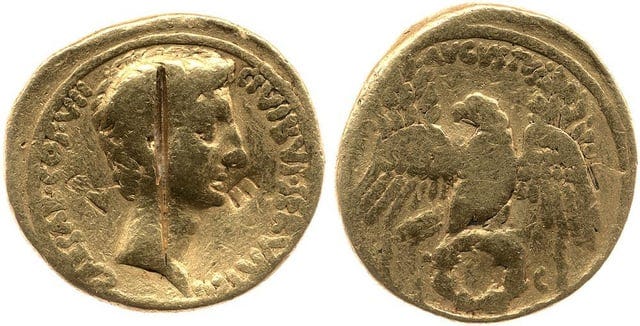
The presence of smelting furnaces and slag heaps at Chennimalai and Karur shows that the region exported iron and steel to the Mediterranean, while beryl gemstones mined at , Padiyur, and Vaniyambadi were prized in Roman markets.
Initially, Roman ships did not sail beyond Cape Comorin; merchants arriving on the western coast transported goods overland through the Palakkad Gap, passing Coimbatore, Erode, and Karur to reach the eastern ports. By the mid-first century CE, however, Roman ships began to sail directly to the Tamil coast, establishing seaborne links with Puhar and Korkai.
Testimony of Classical Sources
The Periplus of the Erythraean Sea (c. 50–60 CE), written by a Greek-Egyptian navigator, is the most valuable foreign account of Tamil trade. It refers to a number of ports such as Komari (Kanyakumar), Kolsi (Korkai), Kaamera (Kaveripoompattinam), Poduga (Arikamedu) and Nigam (Nagappattinam)
It refers to Muziris as a major port of the Cheras, “abounding in ships from Arabia and Greece.” North of it lay Tyndis (Tondi) and Naukra (Kannanoor), while southward were and other Pandyan ports famous for pepper and the aromatic leaf. It must be noted that the Tondi mentioned here is in Chera Nadu and not to be confused with another Tondi in the eastern coast. It was ruled by a clan of Cheras known as ‘Porayars’.
The author lists imports such as gold, coral, glass, copper, tin, lead, wine, and textiles, and exports including pepper, pearls, ivory, silk, diamonds, sapphires, and tortoiseshells.
A few decades later, Ptolemy’s Geography (c. 125 CE) provides a more extensive map of the Chola coast and the regions east of it, revealing that Roman knowledge of South and Southeast Asia had grown considerably.
The Vienna Papyrus: A Window into Maritime Commerce
Perhaps the most striking proof of Indo-Roman trade is the Vienna Papyrus, a 2nd-century CE Greek contract preserved in the Kunsthistorisches Museum. It documents an agreement between a merchant from Muziris and another from Alexandria concerning goods purchased and shipped from India to Egypt.
The papyrus specifies quantities, values, and the 25 percent customs duty payable to Roman authorities. The cargo — 700 to 1700 pounds of citron oil, 4700 pounds of ivory, and nearly 800 pounds of textiles — was worth the price of 2400 acres of Egyptian land. It mentions credit arrangements and loan repayment terms, indicating the existence of sophisticated financial mechanisms. The Ilamichai tailam or citron oil, also called the “Perfume of the Ganges,” was produced in northern India but exported through Tamil ports, showing the integration of inland and coastal trade networks.
This document proves that private entrepreneurs were capable of handling enormous consignments and that Tamil ports served as intermediaries between India’s interior and the Roman world.
Reorientation of Trade
The flourishing Indo-Roman trade began to change after the death of Nero in 68 CE and the ensuing political turmoil. Emperor Vespasian introduced austerity laws discouraging luxury imports. Thereafter, Rome’s demand shifted toward essential goods such as pepper and cotton, while luxury items like silk and emeralds were traded within Asia.
Nevertheless, papyrus evidence shows that luxury goods, especially ivory, continued to be exported to Rome even in the 2nd century CE. Another factor influencing trade was the closure of the overland Silk Route due to Parthian control in Central Asia. Consequently, Chinese silk reached the Chola-mandala ports by sea, from where it was stored in warehouses and later shipped to the Mediterranean. The Tamil coast thus became the new hinge of the maritime Silk Route, bridging the Far East and the Roman world.
Money, Credit, and Banking Practices
While some early scholars believed that ancient Tamil trade operated purely through barter, archaeological and literary evidence contradicts this. The scale of long-distance maritime commerce would have been impossible without monetary exchange. Excavations at Karur along the Amaravati River have yielded large hoards of Chera coins, including copper issues of the 2nd century CE and silver coins of the 3rd century CE bearing symbolic designs.
Roman coins also circulated widely. Many carry tiny punched marks — dots, crescents, or letters — perhaps indicating authentication or ownership. The presence of cut coins and stamped symbols suggests official reuse and control, similar to modern endorsements. These markings could identify the depositor when coins were handed to creditors, hinting at the existence of rudimentary banking systems.
Imitation Roman coins found in India were likely local reproductions for trade, not for forgery. Their metal purity and craftsmanship matched the originals, implying they were produced either by Roman craftsmen in India or by Indian artisans trained in Roman techniques.
The circulation of foreign currency can be explained by the growing need for liquidity during the trade boom of the 1st century CE. Local mints may have been unable to supply enough coinage; Roman coins, trusted for their uniform quality, filled the gap.
Economic and Cultural Impact
The wealth generated by maritime commerce profoundly reshaped Tamil society. Cities such as Puhar, Uraiyur, Karur, and Madurai grew into vibrant urban centres. Artisans specialized in weaving, metalwork, and gem polishing. Temples and royal treasuries benefited from mercantile endowments, while poets found patrons among affluent traders.
Sangam verses portray merchants as honourable and adventurous — “those who crossed the roaring seas and returned with treasures.” Trade was seen as a dharmic pursuit, a legitimate means of earning wealth while contributing to the prosperity of the realm.
The maritime routes also served as conduits of culture. Along with goods came ideas, religions, and artistic motifs. Roman glass and pottery techniques influenced Indian craftsmanship; conversely, South Indian religious art and the Bhakti tradition travelled eastward. Tamil monks and artisans carried Buddhist and Hindu ideas to Sri Lanka and Southeast Asia, leaving traces in art and architecture.
Continuity and Legacy
By the early centuries CE, Tamilakam had become a major maritime power of the Indian Ocean. Its ships connected the Roman Empire in the west with China. The Periplus and Ptolemy describe its coast as a land of wealth, order, and excellent harbours. Even after Roman demand declined, Tamil merchants retained their prominence under the Pallavas, Pandyas, and Cholas, who expanded trade to China and Southeast Asia.
The maritime tradition endured through the medieval period. The Chola kings of the 10th–12th centuries CE launched overseas expeditions and maintained diplomatic and commercial ties with Srivijaya, Java, and Sumatra, echoing the ancient seafaring spirit of the Sangam age.
The maritime trade of the Tamils in ancient India stands as one of the earliest and most sophisticated examples of global commerce in history. It linked three continents through a seamless web of ports, trade routes, and cultural exchange.
From the bustling markets of Puhar and the pearl banks of Korkai to the papyrus contracts of Vienna and the Roman amphorae of Arikamedu, the evidence reveals a civilization that mastered the sea with both enterprise and elegance. Its merchants not only carried pepper, pearls, and textiles across the oceans but also ideas, art, and faith.
In an age when much of the world’s economy was localized, the people of Tamilakam looked beyond their shores, forging maritime networks that anticipated the later Silk and Spice Routes by many centuries. Their legacy reminds us that globalization is not a modern invention — it is a continuation of a story first told by the sailors and poets of the ancient Tamil coast.
References
Sangam Texts
Kadal Vazhi Vanigam by Narasaiah
Pazhanthamizh Vanigarkal by Kanakalatha Mukund translated by S.Krishnan
Arikamedu Archealogical Report
Tamil Coins - A Study by Dr. R. Nagasamy
This was a nice read about Tamilagam and its maritime prowess/ influence. I remember reading about the records of foreigners (Greeks/ Yavanas) who had come to Tamilagam, and was fascinated to know that trade between these far flung lands were actually robust and well.